Camp Kitchen Setup Guide: Essential Gear Checklist for Car Camping
⚠ Affiliate disclosure: We may earn a commission if you purchase through our links, at no extra cost to you. This helps us keep creating free content for Aussie campers.
Last updated:
In This Guide
A well-set-up camp kitchen is the difference between eating well in the bush and surviving on two-minute noodles and cold baked beans. The good news is you don’t need a lot of gear — just the right gear, organised properly.
This guide covers everything you need for a complete car camping kitchen: what to buy, how to organise it, and how to do it without spending a fortune. We’ve structured it around a core gear checklist and three budget tiers so you can build a setup that suits your camping style and your wallet.
Key Takeaways
- A complete car camping kitchen needs five categories of gear: cooking, cleaning, food storage, coffee, and utensils
- A $150 entry-level setup covers the essentials for occasional camping — upgrade from there as you go
- Keep your food esky and drinks esky separate — it extends food life significantly
- Cooking in shade, out of the wind, and near a water source makes camp cooking much easier
- Coleman Classic 1-Burner is the best value two-burner-equivalent for car camping on a budget
- The GSI Outdoors Pinnacle Camper is the upgrade pick for a complete car camping cook set
The Camp Kitchen Gear Checklist
Break your camp kitchen into five categories. Tick off the essentials first, then add the nice-to-haves as your budget and experience grows.
Cooking Gear
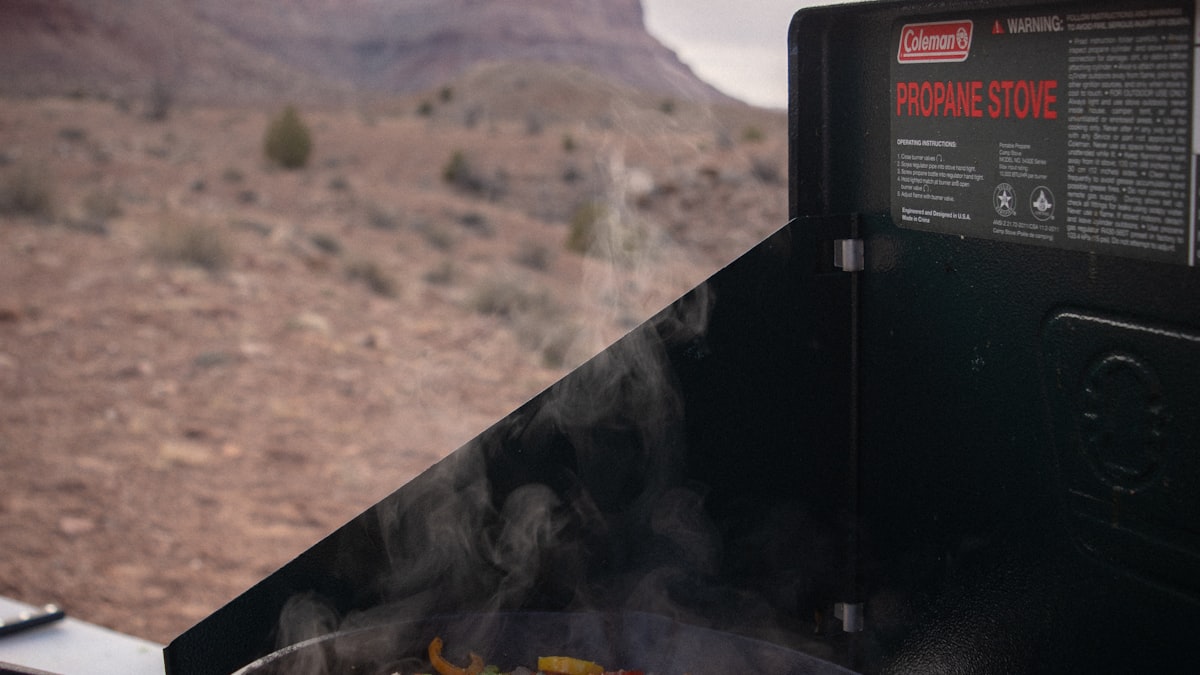
Stove (essential) The heart of your camp kitchen. For car camping, a single-burner canister stove like the Coleman Classic 1-Burner or a compact two-burner propane setup gives you the most flexibility. Backpacking stoves like the MSR PocketRocket 2 work but are small — fine for one person, tight for two or more.
Cookware set (essential) At minimum you need: one medium pot (1.5–2L), one frying pan or skillet, and lids for both. The Stanley Adventure Cook Set covers this for under $80. Step up to the GSI Outdoors Pinnacle Camper if you want non-stick coating and a more complete kit.
Camp oven or Dutch oven (optional) If you’re doing roasts, slow-cooked stews, or baking damper, a cast iron camp oven is a game-changer. Heavy and bulky, but for car camping it’s worth the weight. Leave it home for backpacking.
Grill plate or griddle (optional) A flat cast iron grill plate that sits over your stove opens up a lot more cooking options. Great for breakfast — eggs, bacon, haloumi — and for grilling meat quickly.
Kettle (essential if you drink tea or coffee) A dedicated camp kettle is faster than boiling in a pot and better suited to pouring. Lightweight stainless steel camp kettles start from around $25.
Gas canisters / fuel (essential) Budget 1–2 small isobutane canisters per day for a canister stove, or check the runtime on your propane cylinder. Always bring one more than you think you need.
Lighter or matches (essential) Two lighters — one in your camp box, one in your pocket. Don’t rely on the piezo ignition on your stove as the sole ignition source.
Cleaning Gear
Two collapsible basins (essential) One for washing, one for rinsing. Collapsible silicone basins pack flat and are the standard for car camping. Get at least 5L capacity.
Biodegradable camp soap (essential) Regular dishwashing liquid is fine at established campgrounds with plumbing. If you’re disposing of grey water in the bush, use a biodegradable soap like Camp Suds or Camprex.
Scourer and sponge (essential) A non-scratch scourer for cookware and a sponge for plates and cups. Pack them in a small zip-lock to keep them separate from food items.
Drying rack or microfibre cloth (recommended) A small fold-flat drying rack keeps gear off the table while it dries. A microfibre tea towel is lighter and works just as well.
Grey water waste bag (essential for remote camping) A sealable grey water bag lets you collect and pack out washing water in areas where no grey water disposal is available.
Food Storage
Hard-sided esky (essential) For a weekend trip, a quality hard-sided esky with ice is fine for food. 35–45L suits most couples. Get a separate smaller esky or cooler bag for drinks — it’ll get opened constantly and you don’t want it warming up your food supply.
12V fridge (upgrade pick) For trips of three days or more, a quality 12V fridge like the Dometic CFX3 35 is worth every dollar. Ice-dependent cooling is unreliable on hot days and the logistics of buying ice on a road trip get old fast.
Dry storage containers (essential) Hard-sided containers for pantry staples: oil, salt, pepper, coffee, sugar, spices. Keeps everything organised and protects from insects and moisture. Decant olive oil into a small squeeze bottle rather than bringing the full bottle.
Zip-lock bags (always useful) For marinated meats, leftovers, portioned ingredients. Bring more than you think you need.
Spice kit (recommended) A small travel spice case with your essentials: salt, pepper, garlic powder, paprika, cumin, mixed herbs. You can cook a lot of camp food well with just these.
Coffee Gear
Good coffee matters in the bush. Don’t let this category be an afterthought.
AeroPress Go Travel Coffee Press
At a Glance
- Makes genuinely excellent coffee in the bush — far better than instant
- Brews a full cup in 1-2 minutes with minimal effort
- Built-in travel mug doubles as the carrying case
- Virtually indestructible BPA-free plastic
- Dead-easy cleanup — pop out the puck, give it a rinse, done
- Only brews 1-3 cups per press — not practical for large groups
- Requires paper filters or a separately purchased metal filter
- Still needs a separate kettle or stove to heat the water
The AeroPress Go makes a proper, rich cup that puts instant coffee to shame and packs down into its own mug.
30-day Amazon returns Secure checkout
The AeroPress Go is the best camp coffee maker for most campers — compact, makes genuinely excellent coffee, and cleans up in seconds. Pair it with a camp kettle or your stove pot to boil water.
For groups or if you want a more classic camp experience, a stovetop percolator is the traditional choice. It makes strong, robust coffee and can sit on any stove or fire (when permitted). Heavier and bulkier than the AeroPress but produces a big pot of coffee at once.
Utensils and Eating Gear
Cutlery set (essential) Camping cutlery sets are cheap and pack small. One fork, knife, and spoon per person. Titanium sporks are the ultralight alternative.
Plates and bowls (essential) Enamel, stainless steel, or GSI-style hard plastic camp plates. One deep bowl and one flat plate per person covers most meals.
Mugs (essential) Wide, sturdy camp mugs. Insulated mugs like the Stanley Classic Legendary Camp Mug keep drinks hot longer — essential on cold nights.
Cutting board (essential) A lightweight polyethylene cutting board. The flexible roll-up style is camp-friendly.
Chef’s knife (essential) One good 20cm chef’s knife does most prep work. Wrap it in the cutting board for transport.
Tongs and spatula (recommended) For frying and BBQ cooking. Silicone-tipped to protect non-stick surfaces.
Can opener (essential) Obvious, but frequently forgotten. Attach a small P-38 army can opener to your camp kit keyring and you’ll never forget it.
Budget Tiers: Building Your Camp Kitchen
Entry Level — Around $150
Good enough for weekend car camping. Covers the essentials.
- Stove: MSR PocketRocket 2 or Coleman single burner (~$80)
- Cookware: Stanley Adventure Cook Set (~$80)
- Cleaning: Collapsible basins ($15), camp soap ($8)
- Coffee: AeroPress Go (
$55) or Bialetti moka pot ($35) - Utensils: Basic camp cutlery and enamel plates (~$20)
Total: ~$180–200 (trim by borrowing or improvising some items)
This setup handles two people for a weekend trip without issues. The gaps: no non-stick cookware, basic stove heat control, no insulation for keeping food hot.
Mid-Range — Around $300
The sweet spot for regular campers. Better cookware and a proper stove.
- Stove: Coleman Classic 1-Burner (
$100) or two-burner Coleman propane ($150) - Cookware: GSI Outdoors Pinnacle Camper (~$150)
- Cleaning: Collapsible basins, biodegradable soap, drying rack (~$40)
- Coffee: AeroPress Go + camp kettle (~$80)
- Utensils: GSI Outdoors camp cutlery set (
$35), cutting board, knife ($40) - Storage: 2x 2L Nalgene-style containers for dry goods (~$25)
Total: ~$320–370
This setup cooks well, cleans easily, and fits in a 40L storage tub.
GSI Outdoors Pinnacle Camper Cook Set
At a Glance
- Genuinely complete kit — 2 pots, frypan, 4 mugs and lids, all in one set
- Teflon non-stick coating on both pots and the pan makes cooking and cleaning easy
- Everything nests compactly together with a mesh carry sack included
- Welded handles are more reliable than riveted designs and stay cooler
- Excellent value for a full non-stick camp kitchen setup at $120
- Non-stick coating will degrade over time — avoid campfire cooking directly on coals
- Too heavy at 1.6kg for anything but car camping
- Plastic mugs feel flimsy compared to the quality of the pots and pans
The GSI Pinnacle Camper is the best complete camp kitchen set we've tested at this price — non-stick on everything, a proper frypan included, and four mugs that actually nest inside the pots.
30-day Amazon returns Secure checkout
Premium — Around $500
Everything you need for serious car camping or an extended 4WD trip.
- Stove: Jetboil Flash for boiling + Coleman two-burner for cooking (~$250)
- Cookware: GSI Outdoors Pinnacle Camper + cast iron frying pan (~$230)
- Cleaning: Quality basins, biodegradable soap, grey water bag, drying rack (~$60)
- Coffee: AeroPress Go + GSI JavaPress for groups (~$90)
- Utensils: Titanium cutlery, enamel plates, insulated mugs (~$80)
- Storage: Full spice kit, 4x hard-sided containers, zip-locks (~$60)
Total: ~$480–560
Add a 12V fridge at this level and you have a genuinely excellent camp kitchen capable of feeding a family of four well, every night.
Coleman Classic 1-Burner Butane Stove
At a Glance
- One of the cheapest reliable camp stoves you can buy in Australia
- Very stable cooking platform with a wide, solid base
- Easy-to-use butane canisters available at most supermarkets and servo stops
- Wind guards help maintain a consistent flame in light breezes
- Works with any pot, pan or billy you care to throw on it
- Heavy at 1.4kg — strictly a drive-to-campsite stove, not for hiking
- Butane canisters struggle below 5°C — not ideal for alpine or winter camping
- No precision simmer control compared to quality canister stoves
For car camping on a tight budget, the Coleman Classic does exactly what it promises — a solid, no-fuss stove that'll cook your snags and boil your billy without complaint.
30-day Amazon returns Secure checkout
Camp Kitchen Setup Tips
Set up in shade if possible. Cooking in direct Australian sun is miserable — not just for you, but because it makes temperature control harder and food goes off faster on prep surfaces. If shade isn’t available, a pop-up shelter over the kitchen area is worth having.
Cook upwind of your tent and sleeping area. Food smells attract insects and wildlife. Keep the kitchen at least 10–15m from your sleeping area when camping in areas with wildlife.
Position near water access. Washing up is much easier if you’re close to a tap or water carrier. Set up your kitchen close to your water source, not at the far end of the campsite.
Use a windscreen on your stove. Australian bush can be windy. A basic aluminium windscreen around your stove improves fuel efficiency dramatically and stabilises the flame for better cooking control.
Pack your camp kitchen together. Everything kitchen-related should live in one dedicated box or tub. You shouldn’t be searching through multiple bags for your can opener when dinner is on the boil.
Prep as much as possible before you leave home. Marinated meats, pre-chopped vegetables, pre-mixed spice blends — prep at home and you have much less to do at camp. Makes cooking faster and reduces the amount of equipment you need.
+ What's the minimum gear I need to set up a camp kitchen?
The bare minimum is a stove, a pot, a mug, eating utensils, a lighter, and something to wash up with. A Coleman single-burner or MSR PocketRocket 2 for cooking, a 1.5–2L pot, a titanium spork, and a small sponge with biodegradable soap covers you for solo cooking. For two people, add a second pot or a frying pan and extra plates and mugs.
+ Should I use a camp table for cooking?
Highly recommended, yes. Cooking at ground level puts your stove near dry grass and makes it hard to see what you're doing. A fold-out camp table lifts everything to a comfortable working height, keeps the stove stable, and makes cleanup easier. Even a cheap folding table from Kmart or Big W does the job adequately for occasional campers.
+ What's the difference between a camp kitchen box and a chuck box?
They're essentially the same thing — a portable box that holds your camp kitchen gear. A chuck box is the traditional term. In Australia you'll often see them called camp kitchen boxes or camp kitchens. Some are simple wooden or plastic boxes. Others are elaborate setups with fold-out surfaces, shelving, and drawers. For car camping, a basic plastic storage bin with a lid can work just as well as a fancy purpose-built chuck box.
+ Do I need a separate esky for drinks vs food?
It's strongly recommended. A drinks esky gets opened constantly — every 20 minutes in hot weather — which causes ice or refrigerant to warm up quickly. Your food esky should be opened only when needed. Keeping them separate makes food last significantly longer. A 12V camping fridge for food and a traditional ice esky for drinks is the best setup for extended trips.
+ How do I handle washing up in the bush?
Use biodegradable camp soap — standard dishwashing liquid is fine for established campgrounds with proper waste facilities, but biodegradable soap is important if you're disposing of grey water in the bush. Two collapsible basins work well: one for soapy wash water, one for rinse water. Dispose of grey water at least 50m from any watercourse. A small drying rack or a clean towel completes the setup.
+ What fuel does the Coleman Classic 1-Burner use?
The Coleman Classic 1-Burner runs on propane, or propane/butane mix cylinders — specifically the larger Coleman-branded screw-top canisters or standard camping propane cylinders. It doesn't use the small isobutane canisters that backpacking stoves like the MSR PocketRocket use. For extended car camping, the larger canisters are more economical.
+ How much space does a camp kitchen take up in a 4WD?
A well-organised camp kitchen can fit in a 40–60L storage tub, which is manageable in most dual-cab ute trays or 4WD rear storage setups. A drawer system in the back of a 4WD with a dedicated kitchen drawer is the most efficient setup. The stove is usually the bulkiest single item — side-by-side two-burner stoves take more space but give you more cooking surface.
Written by Rhys · Brisbane, Australia
Brisbane-based 4WD tourer and gear analyst with years of hands-on testing across Australian conditions. Every recommendation on this site is based on real-world use, spec analysis, and long-term owner feedback — not marketing materials.
- · Australian 4WD touring and gear testing since 2019
- · Independent reviewer — no sponsored content, no free product loans
- · Products analysed on specs, real-world owner feedback, and Australian conditions