
How to Choose a Camping Stove: Canister vs Butane vs Multi-Fuel
⚠ Affiliate disclosure: We may earn a commission if you purchase through our links, at no extra cost to you. This helps us keep creating free content for Aussie campers.
Last updated:
In This Guide
Walk into any BCF, Anaconda, or Snowys and the camping stove aisle can feel overwhelming — there’s a wall of options at wildly different price points and in very different shapes. Integrated systems, single-burner canister stoves, tabletop butane cookers, multi-fuel stoves. It’s not obvious what the differences are or which one suits your camping style.
This guide cuts through the noise. We’ll explain every major fuel type and stove style, cover Australian-specific factors like fire bans and fuel availability, and give you a clear recommendation based on how you actually camp.
Key Takeaways
- Isobutane canister stoves are the best choice for hikers and backpackers in Australia
- Butane stoves are cheaper and more convenient for car camping but struggle in cold weather
- Gas stoves are generally allowed during fire bans — but always check your state's rules on the day
- You can't fly with gas canisters — buy fuel at your destination if you're flying to a trailhead
- For most Australian camping, a $75 MSR PocketRocket 2 or ~$45 Coleman butane stove is all you need
- Liquid fuel stoves are overkill for most Australian conditions
The Main Fuel Types
Isobutane/Propane Canister Stoves
Isobutane canister stoves are the standard for backpacking and hiking in Australia. The canister contains a pressurised mixture of isobutane and propane — a blend that performs well across a wide range of temperatures and is extremely convenient to use. Screw the canister on, light the burner, cook.
Best examples: Jetboil Flash ($180), MSR PocketRocket 2 ($75), Primus Lite Plus (~$150)
Pros:
- Lightweight — canister stove heads weigh as little as 73g (MSR PocketRocket 2)
- Clean-burning fuel with no smell and no mess
- Easy to use — screw-on connection, reliable ignition
- Works well across Australian temperature ranges
- Fuel available at BCF, Anaconda, and outdoor stores nationwide
Cons:
- Can’t fly with canisters — need to buy at destination
- Performance drops in very cold temperatures (below -5°C) — not common in Australia but relevant for alpine winter trips
- Empty canisters need proper disposal — most camping areas have hazardous waste bins
- More expensive fuel per meal than butane
Best for: Backpackers, hikers, anyone who carries their stove more than 50 metres from their vehicle.
Butane Canister Stoves
Regular butane stoves use a different canister — typically a slim cylindrical cartridge that clips or screws into a tabletop burner. You’ve seen these at every camping site — the ubiquitous single-burner with a silver cartridge. The Coleman Classic is the most common example in Australia.
Best examples: Coleman Classic 1-Burner (~$45), Iwatani tabletop butane stoves
Pros:
- Very affordable — stoves from ~$45, cartridges from ~$3–5 each
- Cartridges are available everywhere: service stations, supermarkets, hardware stores
- Simple to use — no setup, no fuss
- Decent heat output for cooking proper meals
- Popular at campsites, festivals, and van life setups
Cons:
- Butane loses performance below ~5°C — not suitable for alpine or cold-weather camping
- Heavier and bulkier than canister backpacking stoves
- Not designed for hiking — tabletop format only
- Fuel efficiency isn’t as good as isobutane systems
Best for: Car campers, caravan setups, festivals, van life, anyone who camps from a vehicle and wants a cheap, no-fuss cooking solution.
Propane Stoves
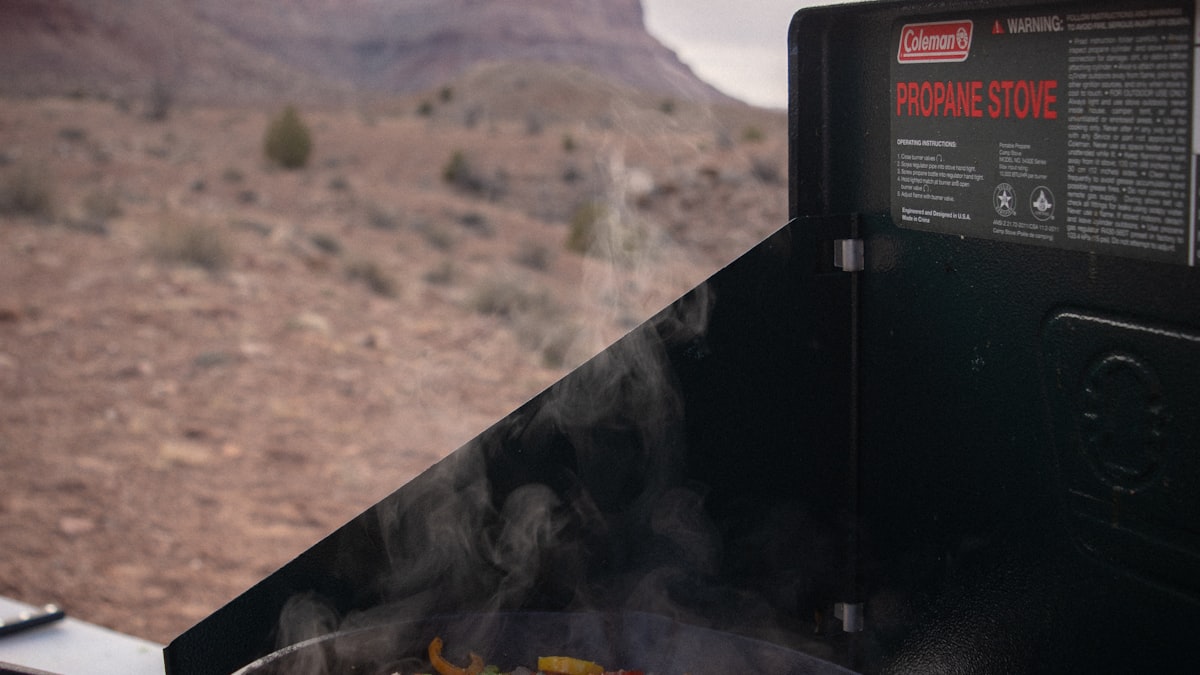
Propane is a high-performance fuel used in larger camp stoves — usually two-burner stoves on a stand, similar to a portable kitchen. Propane canisters are large and heavy but contain a lot of energy and perform well in cold weather.
Best examples: Coleman two-burner propane stoves, Camp Chef camp kitchens
Pros:
- High heat output — great for cooking large meals quickly
- Two-burner options give you genuine kitchen flexibility
- Performs well in cold weather
- Long canister life for extended trips
Cons:
- Heavy and bulky — not suitable for hiking
- Propane canisters aren’t as commonly stocked as butane in Australia
- Overkill for solo or couple camping
Best for: Group car camping, families, extended stays where you’re cooking full meals for 4+ people.
Liquid Fuel Stoves
Liquid fuel stoves (like the MSR WhisperLite or Dragonfly) burn white spirit, unleaded petrol, or kerosene. They were the backpacking standard before isobutane became widely available and are still used for extreme conditions.
Best examples: MSR WhisperLite (~$220), MSR DragonFly
Pros:
- Perform excellently in extreme cold — fuel doesn’t lose pressure at low temperatures
- Can use multiple fuel types in an emergency (unleaded petrol, kerosene)
- Fuel is available almost everywhere in the world
- Powerful heat output
Cons:
- More complex — require priming and maintenance
- Fuel spills and fumes — messy compared to canister stoves
- Heavier than canister stoves
- Significant overkill for most Australian conditions
Best for: Serious alpine expeditions, overseas trips to extreme environments. For most Australian hiking, you don’t need one.
Fuel Type Comparison
| Fuel Type | Cold Weather | Convenience | Weight | Price | Best For |
|---|---|---|---|---|---|
| Isobutane/Propane | Good | Very High | Light | Mid | Hiking & backpacking |
| Butane | Poor below 5°C | Very High | Mid | Low | Car camping & festivals |
| Propane | Excellent | Low | Heavy | Low per meal | Group car camping |
| Liquid Fuel | Excellent | Low | Mid | Low | Extreme alpine expeditions |
Stove Types Explained
Integrated Systems (Jetboil, MSR Reactor)
Integrated systems combine a stove burner and a cooking cup in one unit. The cup has a heat exchanger built into the base that wraps heat around the pot rather than letting it escape into the air. The result is dramatically faster boil times and better fuel efficiency.
The Jetboil Flash is the most popular example — it boils 500mL in about 100 seconds and gets approximately 12 litres of boiling water per 100g of fuel. That efficiency means you carry less fuel on a long hike.
The trade-off is versatility — integrated systems are optimised for boiling water and don’t cook other types of food as well as conventional setups.
Best for: Hikers who mainly cook freeze-dried meals, instant oats, and hot drinks.
Conventional Canister Stoves (MSR PocketRocket 2, Primus Lite Plus)
These stoves are just the burner — you attach any canister and use any pot. The burner head folds down to a compact size and weighs next to nothing (73g for the PocketRocket 2). You choose your own pot, which means you can bring the right size for your group and cooking needs.
The trade-off versus integrated systems is efficiency — heat escapes around the sides of an unenclosed pot, so you use more fuel per litre of water boiled.
Best for: Hikers who want to cook real meals, use different pot sizes, or keep pack weight down.
Tabletop Butane Stoves (Coleman Classic)
These stoves sit flat on a table surface and use butane cartridges. They’re simple, affordable, and produce enough heat for proper camp cooking. They’re not designed to be carried far — they’re car-camping stoves.
Best for: Car campers, caravans, van life, anyone cooking at a fixed campsite.
Australian-Specific Factors
Fire Ban Rules
Australia’s fire ban system is serious business. In all major states, gas stoves with an enclosed flame are generally permitted during Total Fire Bans — but the rules vary by state and can change daily.
- NSW: Gas stoves permitted in solid fuel fire ban areas when used on a non-combustible surface 2+ metres from any flammable material. Check the NSW RFS website.
- Victoria: Similar rules apply — gas permitted during most bans. Check the CFA website.
- WA: Check DFES before heading out — rules can differ by region.
- Queensland: Generally gas stoves are permitted — check QFES.
The most important rule: always check your state’s fire authority website or app on the morning you plan to cook. Conditions change, and the penalties for illegal fires in Australia are severe.
Never Assume a Fire Ban Doesn't Apply
Fire ban rules change daily and vary by region. A gas stove that was permitted yesterday may not be permitted today if the fire danger rating has changed. Always check current conditions at your state fire authority website before lighting any heat source in the bush.
Fuel Availability
Isobutane canisters (Jetboil, MSR, Primus brand) are available at BCF, Anaconda, Snowys, Paddy Pallin, and outdoor specialty stores in most major towns. In remote areas and small towns, availability is less reliable — stock up before you leave the last major centre.
Butane cartridges are even more widely available — you can buy them at service stations, hardware stores, and supermarkets. For remote touring, butane is the safer bet for fuel availability.
You cannot fly with any gas canister. If you’re flying to a starting point (Hobart for the Overland Track, Cairns for the Tablelands), buy fuel on arrival. Most trail head towns in popular hiking areas stock canisters at outdoor shops.
Cold Weather Performance
For most Australian hiking — even winter trips — isobutane canisters perform adequately. The coldest conditions you’re likely to encounter are alpine areas like the Snowy Mountains, the Victorian High Country, and the Tasmanian Central Highlands, where overnight temperatures can drop to -5°C or below.
At those temperatures, isobutane pressure drops slightly. A simple fix: sleep with your gas canister inside your sleeping bag to keep it warm overnight. It sounds odd, but it works well and is standard practice for alpine hikers.
For genuine cold (consistently below -10°C), a pressure-regulated stove like the Primus Lite Plus or a liquid fuel stove is a better choice. But for 95% of Australian hiking, standard isobutane is fine.
What We Recommend
For hiking and backpacking: Start with the MSR PocketRocket 2 ($75) plus a Sea to Summit pot ($90). It’s the most versatile, affordable, and practical setup for most Australian hikers. If you mainly boil water and want the fastest system, step up to the Jetboil Flash (~$180).
For car camping: A Coleman Classic 1-Burner (~$45) is all most people need. It’s cheap, the fuel is available everywhere, and it cooks perfectly well. If you want more cooking power for groups, a two-burner propane or butane stove is worth considering.
For alpine or winter hiking: The Primus Lite Plus (~$150) with its pressure regulator handles cold better than most canister stoves. Liquid fuel stoves are overkill for all but the most extreme Australian conditions.
See our best camping stoves roundup for our full picks across every budget and camping style.
Frequently Asked Questions
+ What type of camping stove is best for beginners in Australia?
For most beginners, an isobutane canister stove like the MSR PocketRocket 2 is the best starting point. It's simple, lightweight, affordable (~$75), and fuel canisters are available at BCF and Anaconda. For car camping beginners who don't need to carry the stove far, a Coleman butane single-burner (~$45) is even simpler and uses even cheaper, more widely available fuel.
+ Are gas stoves allowed during Total Fire Bans in Australia?
In most Australian states, enclosed gas stoves (canister and butane) are permitted during Total Fire Bans, provided the flame is enclosed, supervised, and used on a non-flammable surface well away from vegetation. Rules vary by state and fire district. Always check with your state's fire authority (NSW RFS, CFA Victoria, DFES WA) on the day you're planning to cook. Do not assume a ban doesn't apply to your stove.
+ Can I fly with isobutane canisters to a trailhead?
No — pressurised gas canisters are not permitted on commercial flights in Australia or internationally. If you're flying to a trailhead, you'll need to buy fuel at your destination. Isobutane canisters are available at BCF, Anaconda, and outdoor stores in most regional centres. Plan your fuel purchase before you head into the bush — remote areas may not stock them.
+ What's the difference between isobutane and butane camping stoves?
Isobutane canisters contain a blend of isobutane and propane under higher pressure. They perform much better in cold weather (maintaining pressure and heat output below 5°C) and are the standard for backpacking stoves (Jetboil, MSR, Primus). Butane operates at lower pressure and loses performance in cold weather — fine for summer car camping but not recommended for alpine or winter hiking. Butane cartridges are generally cheaper and more widely available at non-specialty retailers.
+ How long does a gas canister last for camping?
A 230g isobutane canister lasts approximately 12 litres of boiled water (based on Jetboil's efficiency data). For a solo hiker boiling water for meals and coffee, a 230g canister lasts 3–4 days. For a couple using a conventional stove for cooking, expect 2–3 days per canister. Always carry a spare on trips longer than a weekend, and pick up extra canisters before entering remote areas.
+ Are liquid fuel stoves necessary for Australian hiking?
For most Australian hiking, liquid fuel stoves are unnecessary. The Snowy Mountains and Tasmanian Highlands are the coldest conditions you're likely to encounter, and quality isobutane stoves handle those temperatures with the canister-warming trick (keeping the canister in your sleeping bag overnight). Liquid fuel stoves (like the MSR WhisperLite) make sense for extremely cold alpine expeditions, but for 95% of Aussie hiking, a canister stove is the right tool.
+ What size stove burner do I need?
For solo hiking or couples, a standard single-burner canister stove is all you need. For car camping groups of 4+, consider a two-burner stove — either a large butane double-burner or a propane camp stove. Two burners let you boil water while something is cooking, which makes group meal preparation much more practical. Single-burner stoves work fine for solo and couples camping even in groups — you just need to batch cook.
More Camping Cookware Guides
- Best Camping Stoves Australia — Our top picks for every camping style and budget.
- Jetboil Flash vs MSR PocketRocket 2 — The two most popular stoves compared head-to-head.
- Jetboil Flash vs Jetboil MiniMo — Which Jetboil system is right for you?
Written by Rhys · Brisbane, Australia
Brisbane-based 4WD tourer and gear analyst with years of hands-on testing across Australian conditions. Every recommendation on this site is based on real-world use, spec analysis, and long-term owner feedback — not marketing materials.
- · Australian 4WD touring and gear testing since 2019
- · Independent reviewer — no sponsored content, no free product loans
- · Products analysed on specs, real-world owner feedback, and Australian conditions